Language guide

Find the meanings of Noongar words used here. You can also hover over or select an underlined word as you read.

Broad terms

Boodja
Country.
Kep
Water
Boorn
Trees and plants; the plant collection on this website.
Barna
Animals

Noongar seasons

Birak
A Noongar season. December–January is an approximate calendar guide; conditions on Country shape the season.
Bunuru
A Noongar season. February–March is an approximate calendar guide; conditions on Country shape the season.
Djeran
A Noongar season. April–May is an approximate calendar guide; conditions on Country shape the season.
Makuru
A Noongar season. June–July is an approximate calendar guide; conditions on Country shape the season.
Djilba
A Noongar season. August–September is an approximate calendar guide; conditions on Country shape the season.
Kambarang
A Noongar season. October–November is an approximate calendar guide; conditions on Country shape the season.

Barna and boorn names

Djerap
Birds
Kaarda
Lizards
Yulart
Skinks
Norn
Snakes
Yurkan
Turtles
Kwooyar
Frogs
Djildjit
Fish
Yinbi
Freshwater mussels
Gilgie
Crayfish and shrimp; the group labelled Gilgie on this website.

WHADJUK-OWNED · WHADJUK-LED

Working together
for swamp healing.

A living swamp. Continuing relationships. Care that grows as we learn together.

How we work together ↗

Grogan Swamp is living Boodja. Its waters, soils, plants, animals and people belong to an interconnected living world, extending through Bennett Brook and beyond. Tending to the swamp means nurturing these relationships, listening to what is changing and learning how to respond with care.

Led by Whadjuk Aboriginal Corporation and guided by Whadjuk Elders and authorised Knowledge Holders, Healing Swamp Together welcomes communities, neighbours, young people, researchers and partner organisations into this shared work. We bring different knowledge, skills and connections to Place. Everyone has learning to do, and everyone carries responsibilities in how we work together.

The swamp itself is part of that learning. Returning across the seasons, noticing changes, sharing observations and working alongside one another can deepen our understanding and connection. Knowledge sharing is reciprocal: what we learn should support Country and the people caring for it, while respecting cultural authority and the knowledge entrusted to us.

Healing takes patience, humility and ongoing attention. We make space to reflect, learn from unexpected outcomes and change our approach as our understanding grows. Through this work, we hope to strengthen relationships, skills and shared care that continue well beyond the life of the project.

Healing Swamp Together artwork showing connected waterways surrounded by plants and animals.

One living landscape.
Water, wildlife and people, connected.

230 hathe wider project landscape

8 connected projectsguided by Whadjuk care for Country

2026–2028the project journey

RELATIONSHIPS IN PRACTICE

How our care connects

The plan brings these relationships into view: cultural guidance at the centre of how we work, and eight connected projects growing through knowing, reconnecting, healing and reflection.

Working in the right way

Whadjuk cultural authority, permission, respect and shared learning guide how we come together to care for Country.
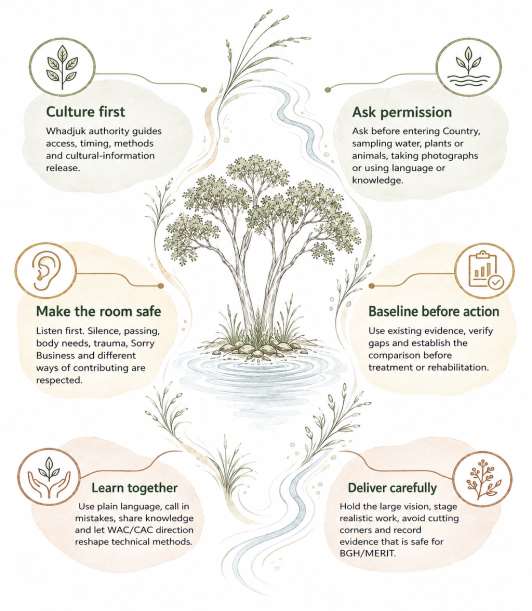
Six right-way principles arranged around a tree and water: culture first, ask permission, make the room safe, baseline before action, learn together and deliver carefully.
Right-way principles · WAC plan, p. 18.
© Whadjuk Aboriginal Corporation 2026
Read the diagram in text
Culture first
Whadjuk authority guides access, timing, methods and cultural-information release.
Ask permission
Ask before entering Country, sampling water, plants or animals, taking photographs or using language or knowledge.
Make the room safe
Listen first. Silence, passing, body needs, trauma, Sorry Business and different ways of contributing are respected.
Baseline before action
Understanding the swamp before work begins helps us recognise what changes and learn from its care.
Learn together
Use plain language, call in mistakes, share knowledge and let WAC/CAC direction reshape technical methods.
Deliver carefully
Care grows through realistic steps, attention to what changes and sharing what we learn.

The Cultural Advisory Committee guides how cultural knowledge and responsibilities shape the work.
Read the principles in the plan ↗

One living whole

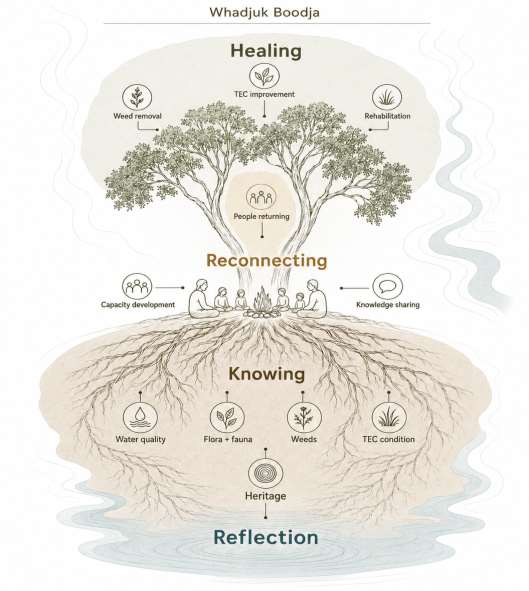
The roots, trunk and canopy belong to one living whole. Our eight projects connect knowledge of the swamp with people returning, sharing and tending over time.

A tree on Whadjuk Boodja connects knowing roots with a reconnecting trunk and a healing canopy. Reflection surrounds the roots.
Knowing, reconnecting and healing · WAC plan, p. 45.
© Whadjuk Aboriginal Corporation 2026
Read the diagram in text

The tree stands on Whadjuk Boodja, with reflection beneath and around its roots.

Knowing roots
Water quality; flora and fauna; weeds; threatened ecological community (TEC) condition; heritage.
Reconnecting
People returning; capacity development; knowledge sharing.
Healing canopy
Weed removal; TEC improvement; rehabilitation.

The connected roots, trunk and canopy show how the projects contribute to the same living whole.

Explore the connections in the plan ↗

EXPLORE THE PROJECT

Different starting points.
The same Country.

Water, habitat, culture and community run through all eight projects. Explore a connection or choose a project to learn more.

Eight ways of caring for one place

Each project is part of the same story: caring for the swamp, strengthening connections with Country and making room for the life it holds.

Loading the eight projects…

GET TO KNOW THE LIVING LANDSCAPE

Meet the life of the swamp.

Explore the plants, birds and other living groups that connect this place. The profiles bring together observations from different years, so there is always more to discover.

Animals and their relationships

Barna

Discover the connections between mussels and fish, rakali and riverbanks, cockatoos and trees.

Plants of the swamp and surrounding landscape

Boorn

Meet native and introduced plants, follow their names and explore photographs, seasonal activity and the places they grow.

Introduced plants within Boorn

Weed explorer

Get to know the weeds recorded here and why careful restoration matters for native life.

103 bird profiles · local evidence and sources

Djerap explorer

Find familiar birds, discover recorded Noongar names and explore photographs, calls and habitats.

NOONGAR SEASONS

Follow the changing life of the swamp.

When do the paperbarks flower? When might young turtles emerge? Explore the project plan’s seasonal map, one living relationship at a time.

Explore the seasons ↗

GROGAN SWAMP & SOUTHERN BENNETT BROOK

A place within
a larger story.

Water moves through channels, wet flats, open water, samphire, sedgeland and wooded swamp before reaching Derbarl Yerrigan. Care here is connected to what happens upstream and around the wetland.

Whadjuk connection to this Country continues. The project grows from that connection, alongside earlier restoration, community care and knowledge of the wetland.

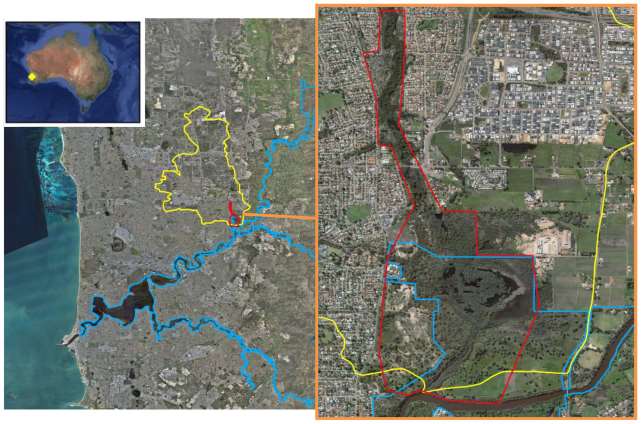
The project sits within a 230 ha landscape. Restoration focuses on particular places within it. Read more in the WAC plan, pp. 5, 11–16 and 24.

Explore the brook’s story ↗

Read about this place ↗
Location overview from the WAC plan, showing Bennett Brook, Grogan Swamp and the surrounding catchment.
Grogan Swamp and Bennett Brook within the wider catchment. From the WAC plan, Figure i, p. 5. This is a location overview, rather than a visitor-access map.

Keep exploring: discover more about the swamp’s wildlife, waterways and history of care.

Care that grows through learning.

The swamp changes with the seasons. Caring for it means paying attention, learning together and returning over time. This is the shared purpose running through all eight projects.

Explore the sources ↗